
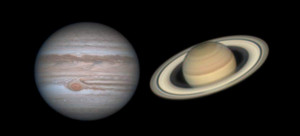
 Our planet has its closest approaches to Jupiter and Saturn this month. Both worlds spend July in the constellation Sagittarius the Archer. They rise in the southeast around sunset, are visible all night long as they pass low across the southern sky, and set in the southwest around sunrise. Jupiter is brighter than any star and easy to spot. Saturn will be six degrees to its left. That’s the width of three fingers held at arm’s length kind of like you’re giving the Scout salute. Both planets appear their biggest and brightest at opposition. That’s when Earth passes between them and the sun. For Jupiter, this happens the night of July 13. Opposition for Saturn is a week later on July 20. The brightening of Saturn might be a little more noticeable then due to the “Seeliger Effect” when the icy particles in its rings are reflected directly back at the sun (and us). If you can look through binoculars or a telescope, Jupiter’s moons and Saturn’s ring are wonderful to enjoy.
According to the Rand McNally Universal Map of Outer Space from 1958 that still hangs on my wall, Jupiter has 12 moons and Saturn has 10. A few more have been discovered in the last 62 year. Saturn now leads with 82 moons and Jupiter is close behind with 79 moons. Since that time at the dawn of the Space Age, we have sent robot explorers named for pioneering astronomers to visit both worlds: Galileo to Jupiter (orbited 1995-2003) and Cassini to Saturn (orbited 2004-2017). Future missions in the 2020s and 2030s will send an 8-bladed rotorcraft called Dragonfly to soar over the methane seas of Saturn’s moon Titan. Other robots will explore the oceans beneath the ice of Jupiter’s Europa and Saturn’s Enceladus looking for signs of life.
If you’re outside the evening of July 4, don’t miss Saturn, Jupiter, and the full moon all in a line. That’s a total of 162 moons! The following night, the almost full moon is below and between Jupiter and Saturn forming a triangle. If it’s cloudy those nights, look again on July 31 and August 1 for similar gatherings. If you need to see even more worlds at one time, head outside the mornings of July 18 and 19 around 4:30 just as the sky is brightening to see all five visible planets. A thin waning crescent moon is rising in the northeast with Mercury below it on Saturday and to its right on Sunday. Venus is brilliant in the east, Mars is higher and reddish in the southeast, and bright Saturn and Jupiter are setting together in the southwest. Six worlds at once! You would need a telescope to see them, but the ice giants Uranus and Neptune and the dwarf planets Ceres, Eris, and Pluto are also in the sky at this time for a total of 11 worlds. Add the one you’re standing on, and that’s an even dozen all while sipping your coffee or tea.
John Heasley is an astronomy educator and stargazer who enjoys connecting people with the cosmos. He volunteers with NASA/JPL as a Solar System Ambassador and the International Astronomical Union as a Dark Sky Ambassador. For more information about stargazing in southwest WI, like Driftless Stargazing LLC on Facebook and find out whenever there’s something awesome happening in the skies. Driftless Dark Skies appears monthly in the Voice of the River Valley.
Going Home to Vernon County
Traveling in the back seat of a 1963 yellow Corvair provided a whole different perspective of Driftless Wisconsin. Winding north along Highway 27, skimming the top of the world like an amusement ride, the landscapes visible from the depths of the back seat flew by...
Shaping the Kickapoo Valley
In Driftless Wisconsin, you can begin to understand the power of water; of glacial meltwater and rivers that have shaped our home over thousands of years since the Wisconsin Glacier stopped short of our corner of the state some 10,000 years ago. North and east of the...
Summer on the Mississippi
Nothing signals summer more than the buzz of fishing boats and the hum of tugboats on the Mississippi. Up close or from a distance, the river never ceases to crave your attention. Traveling the Great River Road along Crawford County’s west coast, there are a number...