
My earliest memory of stargazing is with my mom on a fishing dock in northern Minnesota. We would have competitions to see who could find the first satellite and made wishes on shooting stars. We would lie for hours under the night sky. I didn’t know at that time how lucky I was to experience dark skies; I just knew it was something I looked forward to. We didn’t know the names of the constellations or that shooting stars were meteors. We just knew that lying there, soaking in the photons from distant stars, was an enjoyable thing to do.
Thanks to my mom, I can count myself in the 20% of the North American population that has seen the Milky Way. I never knew how special that was until I was much older and read that 80% of Americans have never seen the Milky Way. I really took for granted that views of our home galaxy were available to me. This realization was one of the factors that led me down the path to becoming a Dark Sky Ambassador, a story for another time. All I knew then was that observing the stars was as commonplace as picking dandelions in the spring or raking leaves in the fall. They were there whenever I looked up.
It wasn’t until I was 41 that I discovered a need to identify what I was looking at. One night while walking my dog I saw a red object in the sky and thought it was Mars. After searching the internet for hours, I discovered it was Antares, a super red giant star that was literally named Anti Ares, or not Mars. This made me laugh and hooked me on learning more about our night sky.
Shortly thereafter, I joined the Iowa County Astronomers. I was captivated and looked forward to their monthly meetings. I loved learning about all things astronomical and would share my experiences with my mom on my drive home from the meetings. She would get so excited and would start sharing her memories of looking up as a young girl. I said “Mom, I didn’t realize that you were so interested in astronomy.” She replied, “Oh yes, I grew up during the space race! I always thought I would be an astronaut and walk on the moon someday.”
It was at that moment that I realized I didn’t start my astronomy journey with Antares but back in my childhood lying on my back with my mom at my side searching for satellites. I said, “Mom, you need to share your excitement and these experiences with my club.” After all, you can’t see all the satellites unless you’ve seen the first one and my mother saw Sputnik, the mother of all satellites.
If you want to hear more about her astronomical journey, you are welcome to attend the October 25th meeting of the Iowa County Astronomers.
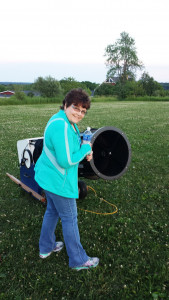
Welcome to guest star, Lynda Schweikert. She is an amateur astronomer with the Iowa County Astronomers, dark sky warrior with the International Dark Sky Association, and was recently named Dark Sky Ambassador with the International Astronomical Union. She enjoys doing astronomical outreach programs, sharing her telescope to show others the wonders of the night sky. For more information about stargazing in southwest WI, like Driftless Stargazing LLC on Facebook and find out whenever there’s something awesome happening in the skies. Driftless Dark Skies appears monthly in the Voice of the River Valley.
Winter’s Residents
We’ll be talking about those friendly people in our next blog post, but meanwhile, let’s park the car and head into the woods to find some of our other winter’s residents. Check out our hiking page and winter activities to locate some of our favorite off-road places....
Driftless Wisconsin Winter
“Yep, pretty, isn’t it,” I replied in my all-knowing grandfatherly voice. The Driftless area astonishes us like this during the winter, more so than the similar flatlander experience, perhaps because the unglaciated landscape rises up to greet our eyes. Towering...
The Driftless Area
The Driftless area is a large peninsula of land, mostly located in Southwest Wisconsin, that went unglaciated throughout the last glacial period, which occurred 10,000 years ago. The word “driftless’ simply refers to the fact that this area lacks glacial drifts. It’s...